
Owls break one of the more consistent patterns in the bird world: across most species in this family, females are the larger sex, a genuine reversal of what’s typical among songbirds and even most other raptors.
Reverse Sexual Size Dimorphism
In Great Horned Owl, Barred Owl, Eastern Screech-Owl, Barn Owl, and Snowy Owl, females typically outweigh and outsize males, sometimes noticeably so. This pattern, called reverse sexual size dimorphism, is widespread across owls and many other raptors, standing in contrast to the male-larger or size-equal pattern found across most of the songbird species.
Why This Might Have Evolved
Researchers haven’t settled on a single confirmed explanation, though several hypotheses are commonly discussed. One proposes that larger females are better equipped to withstand food shortages during the demanding incubation period, since females do most or all incubating in many owl species. Another suggests that a larger female may be better able to defend the nest against predators or competing owls while the male is away hunting.
Why This Remains a Genuine Open Question
None of these explanations has been conclusively proven as the primary driver, and it’s possible several factors contribute simultaneously. This is one of several genuinely unresolved questions, alongside the individually variable migration pattern documented in Blue Jay.
Plumage Differences: Mostly Absent, With One Exception
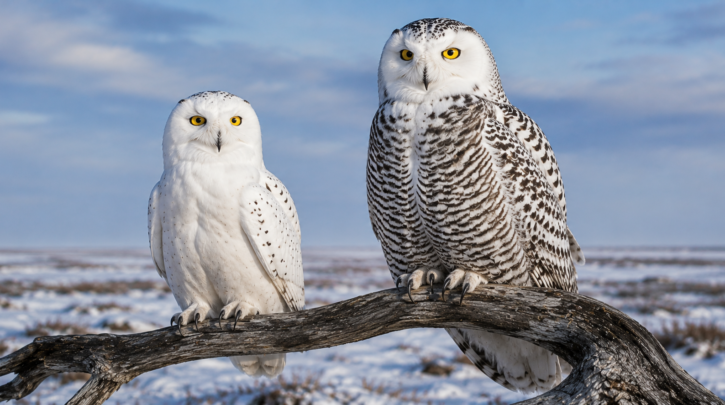
Most owl species show no reliable plumage difference between the sexes beyond size. Snowy Owl is the clear exception among the five species covered here: males are typically much whiter overall, while females and juveniles carry considerably heavier dark barring across the body. This makes Snowy Owl genuinely easier to sex in the field than any of the other four species.
Practical Sexing in the Field
For the four species without a clear plumage difference, size alone is rarely a reliable field mark unless two birds are seen directly side by side, since individual variation within a single sex can overlap with the average size of the other. Behavioral cues — which bird is incubating, which is delivering food — tend to be more useful in practice.
How Researchers Confirm Sex
Researchers studying wild owl populations typically rely on molecular sexing from a blood or feather sample when precise confirmation matters, rather than depending on size or plumage alone, given how much overlap exists between individuals.
A Genuinely Distinctive Pattern in the bird world
No other family shows this specific reversed size pattern, making owls a genuinely useful example of how sexual dimorphism doesn’t follow one universal rule even across birds broadly, let alone within a single closely related family.
Curious about the sensory adaptations both sexes share equally? See our silent flight and hearing guide for some of the most specialized biology.
Does Size Difference Affect Behavior?
Beyond simple size, some researchers have observed behavioral tendencies that track loosely with this pattern — larger females taking a more dominant role in nest defense, for example — though these observations are less rigorously established than the size difference itself, which is genuinely well documented across the family.
A Pattern Shared With Many Other Raptors
Reverse sexual size dimorphism isn’t unique to owls — hawks, eagles, and falcons show a broadly similar pattern, suggesting this trait likely evolved independently, or from a shared ancestral condition, across much of the raptor world rather than being something specific to owls alone.
A Small Detail With a Big Story Behind It
The reversed size pattern covered here is a genuinely small physical detail with a surprisingly large and still-unresolved evolutionary story behind it — a reminder that even a family this well studied still holds real, open scientific questions.
Sexing owls by sight remains genuinely unreliable across most of this family, but knowing why, and knowing where the one real exception lies, is itself useful field knowledge. A patient look at behavior instead of appearance will almost always reveal more than a single quick glance ever could.