
No other bird family shows this much internal variation in nesting strategy — one species builds nothing at all, two rely on cavities, one uses whatever structure it can find, and one simply scrapes a shallow depression into open tundra.
Great Horned Owl: No Construction at All
Great Horned Owl builds no nest of its own, relying entirely on reusing old hawk, crow, or heron nests, cliff ledges, or occasionally large tree cavities. This behavior is genuinely unique enough among the five species covered here to warrant its own dedicated article — see our full explanation.
Barred Owl: Natural Tree Cavities
Barred Owl nests in natural cavities within large dead or dying trees, occasionally using old nests built by other birds or squirrels, and will use a correctly sized nest box where natural cavities are scarce.
Eastern Screech-Owl: A Reliable Cavity and Box Nester
Eastern Screech-Owl’s reliance on old woodpecker cavities is a direct continuation of the same ecological relationship chickadees also depend on — standing dead wood and abandoned excavations quietly support far more species than the birds that originally created them.
Barn Owl: Structures Over Trees
Barn Owl nests in barns, silos, church steeples, cliff crevices, hollow trees, and purpose-built nest boxes, again adding minimal material — sometimes relying on accumulated pellet debris as informal bedding rather than gathering anything fresh.
Snowy Owl: A Bare Scrape on Open Tundra
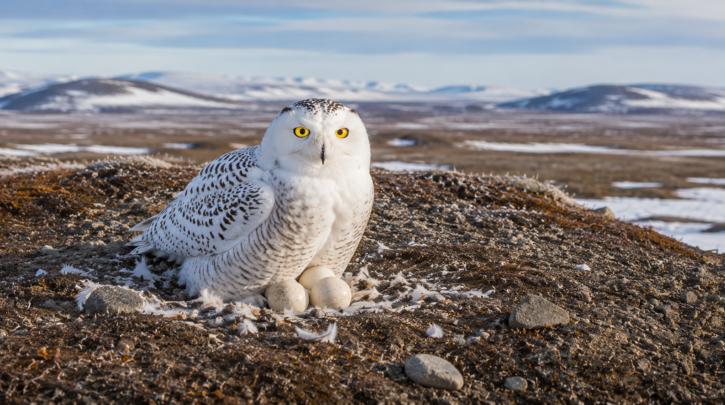
Snowy Owl nests directly on the ground, choosing an elevated tundra hummock or ridge that offers good visibility and drainage, with the female scraping a shallow depression and lining it minimally with vegetation and some plucked feathers.
Within one family of five closely related species, nesting strategy ranges from building absolutely nothing to excavating nothing to simply scraping bare ground — a spread of strategy rarely seen this concentrated anywhere else in the bird world.
A Genuine Callback to the Woodpecker
Eastern Screech-Owl’s reliance on old woodpecker cavities is a direct continuation of the same ecological relationship of chickadees — standing dead wood and abandoned excavations quietly support far more species than the birds that originally created them.
What Comes Next
Once a nest site is secured, egg laying follows within days to weeks depending on species. See our eggs guide for clutch size and incubation, and our baby owls guide for what happens after hatching, including the genuinely unusual “branching” stage several species pass through.
Ready to support cavity-nesting species directly? See our nest box guide for designs built specifically for Eastern Screech-Owl and Barn Owl.
Why This Diversity Exists
This spread of strategies likely reflects how differently habitat and body size shape nesting options across the family — a species living where suitable cavities are scarce but old hawk nests are common takes a very different approach than one nesting on treeless Arctic tundra with no cavities available at all.
Nest Height and Placement
Beyond the basic strategy, placement varies considerably too — Great Horned Owl and Barred Owl nests often sit well up in a mature tree, Eastern Screech-Owl and Barn Owl cavities can range from just a few feet off the ground to considerably higher, and Snowy Owl’s ground scrape sits, by definition, at ground level entirely.
A Reminder About Site Fidelity
Several species show meaningful year-to-year fidelity to a successful nest site, particularly Great Horned Owl reusing the same general nest location across multiple seasons when it remains available and structurally sound, similar to the site fidelity pattern documented in Blue Jay.
A Reasonable Way to Approach Nest Boxes
Because only two of the five species readily accept nest boxes, deciding whether a box makes sense for a given property depends heavily on which species is actually present locally — a box built for Eastern Screech-Owl or Barn Owl offers real value where those species occur, but won’t attract Great Horned Owl, Barred Owl, or Snowy Owl regardless of design or placement.
Checking local range maps before investing in any nest box remains the single most useful first step for anyone genuinely serious about supporting owls on their own property.