
Rat poison creates a genuine, well-documented problem well beyond the rodents it’s actually aimed at — owls and other raptors that eat poisoned rodents accumulate the same toxin, often with fatal consequences.
How Secondary Poisoning Works
Anticoagulant rodenticides work by preventing a rodent’s blood from clotting normally, and a rodent that’s consumed this poison but hasn’t yet died remains an easy, attractive target for an owl or other raptor. The predator then absorbs the same toxin, accumulating it in its own tissue with repeated exposure over time.
Well-Documented in Necropsy Studies
Studies examining dead raptors, including owls, have repeatedly found a high percentage testing positive for rodenticide exposure, confirming this isn’t a theoretical concern but a genuinely widespread, measurable problem across wild raptor populations.
Second-Generation Rodenticides: A Particular Concern
Newer, second-generation anticoagulant rodenticides persist considerably longer in animal tissue and carry higher toxicity than older formulations, making bioaccumulation through the food chain a genuinely greater risk than it was with older rodenticide products.
A Real Policy Response
Some jurisdictions have taken direct regulatory action in response — California, for example, restricted most non-professional use of second-generation anticoagulant rodenticides specifically because of this documented wildlife impact, a genuine real-world policy response to a well-established conservation problem.
The Alternative: Encouraging Owls Directly
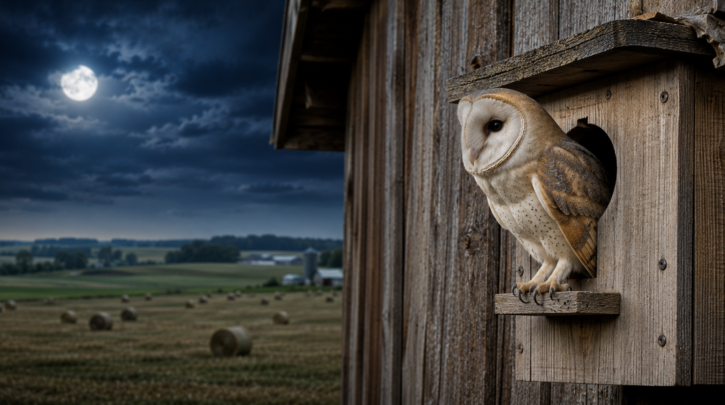
A single Barn Owl family can eat somewhere in the range of one thousand to three thousand rodents in a year, covered in our diet guide — a genuinely substantial, chemical-free pest control service that a well-placed nest box can help make possible.
A single Barn Owl family can eat well over a thousand rodents in a year — a genuinely substantial pest control service that costs nothing and introduces no poison into the food chain at all.
What Hosts and Property Owners Can Actually Do
- Avoid rodenticide entirely wherever a non-chemical alternative is realistic
- Install correctly designed nest boxes to encourage resident owls, covered in our nest box guide
- Use exclusion and sanitation methods — sealing entry points, removing food sources — as a first line of rodent control
- If rodenticide use is genuinely unavoidable, favor enclosed bait stations and lower-persistence formulations over exposed, second-generation products
Why This Is the Single Most Impactful Thing Most Hosts Can Do
Compared to every other action covered across this site, avoiding rodenticide and encouraging natural rodent predators through habitat and nest boxes likely does more for real owl population health than any other single choice a typical property owner can actually make.
Ready to take the most direct step? See our nest box guide for models built for Eastern Screech-Owl and Barn Owl specifically.
A Problem With a Genuinely Available Solution
Unlike many conservation issues that feel too large for an individual property to meaningfully affect, rodenticide use is a genuinely direct, controllable choice, and choosing natural rodent predators over poison is one of the clearest, most actionable things.
A Real Agricultural Case Study
Farms that have installed Barn Owl nest boxes as part of an integrated pest management approach often report meaningfully reduced rodent damage to stored grain and crops — a real, practical strategy already in use, not just a theoretical conservation talking point.
Final Thoughts
Once secondary poisoning has occurred, there’s no real treatment available for an affected wild raptor — prevention is genuinely the only effective approach here. That makes avoiding rodenticide, encouraging natural rodent predators through habitat and nest boxes, likely the single most impactful thing most property owners can do for owl health, more than any other choice covered on this site.
If this guide leaves you with just one takeaway, let it be this: put away the poison, and let the owls do the rest of the work naturally, for free, season after season.