
Young owls follow a developmental path unlike almost anything else in the bird world — a genuinely unique pre-flight stage called branching, and a size hierarchy within the nest created by the staggered hatching covered in our eggs guide.
At Hatching
Newly hatched owlets are altricial: blind, downy, and completely dependent on their parents. Because hatching happens in staggered order rather than all at once, a single brood can include chicks at genuinely different developmental stages simultaneously.
A Real Size Hierarchy Within the Brood
Older, larger chicks generally get fed first, and during a genuine food shortage, this can mean the youngest chick in a brood doesn’t survive — a difficult but genuine biological reality covered honestly in our eggs guide, rather than a sign of parental failure.
Branching: A Genuinely Unique Developmental Stage
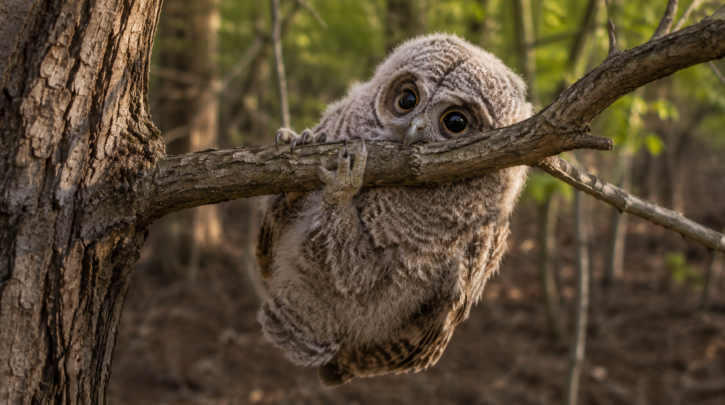
Well before they can actually fly, owlets of several species — particularly Barred Owl and Great Horned Owl — leave the nest or cavity and begin climbing and hopping around nearby branches using both beak and talons for grip. Wildlife rehabilitators and researchers refer to owlets in this stage as “branchers,” a genuine, well-recognized term for a completely normal developmental phase.
Why Branching Happens
Branching likely lets owlets begin building strength, coordination, and balance before attempting real flight, similar in concept to practice runs, all while remaining close enough to the nest site for parents to continue feeding them during this transitional period.
A Brancher on the Ground Isn’t Necessarily in Trouble
A young owl found on the ground near a nest tree, clearly not yet flying, is very often a normal brancher rather than an injured or abandoned bird — a genuinely common source of well-meaning but unnecessary wildlife rescue calls. Parents typically remain nearby and continue feeding a grounded brancher, and it can often climb back up on its own given time.
When Intervention Actually Makes Sense
Genuine signs of injury — visible wounds, an inability to grip or climb at all, obvious distress well beyond normal brancher clumsiness — are better reasons to contact a wildlife rehabilitator than simply finding a young owl on the ground, which alone is not evidence of a problem.
Fledging Timeline by Species
First real flight typically happens five to ten weeks after hatching depending on species, with Eastern Screech-Owl generally fledging faster, around four to five weeks, than the considerably larger Great Horned Owl and Barred Owl, which can take six to ten weeks.
An Extended Period of Continued Dependence
Even after fledging and gaining real flight ability, young owls remain dependent on their parents for continued feeding and hunting instruction for weeks to months, gradually developing the skills covered in our hunting guide before achieving genuine independence.
Curious what hunting skill development actually looks like during this period? See our nocturnal behavior and hunting guide for the full picture.
A Season Worth Watching From a Distance
For anyone lucky enough to locate an active owl nest or a family of branchers nearby, the most rewarding approach is patient, distant observation over multiple visits — letting hatching, branching, and eventual flight unfold naturally at their own pace. A grounded young owl showing normal alertness, able to grip and attempt to climb, and positioned near a known nest tree is very likely a healthy brancher rather than an animal in need of rescue.
Patience, more than any specific piece of gear or technique, is the most valuable skill anyone can bring to watching young owls develop.