
Nocturnal hunting defines this family in the popular imagination, but the real picture is genuinely more varied — several species show meaningful daytime activity, and one breaks the pattern almost entirely.
Genuinely Nocturnal Species
Eastern Screech-Owl and Barn Owl are both predominantly active after dark, relying heavily on the silent flight and sound-based hunting covered in our silent flight guide to locate and capture prey in genuine darkness.
Crepuscular Tendencies
Great Horned Owl and Barred Owl both show real activity at dawn and dusk in addition to full night, and Barred Owl in particular is known to call, and occasionally hunt, during full daylight more often than most of its relatives.
Snowy Owl: A Genuine Daytime Exception
Snowy Owl breaks the nocturnal pattern almost entirely, remaining active during the day even outside the continuous daylight of an Arctic summer. This daytime activity likely reflects both its Arctic origins, where nocturnal hunting simply isn’t possible for much of the year, and its reliance on more visually driven hunting over open ground rather than the sound-based ambush typical of forest-dwelling relatives.
Daytime Roosting
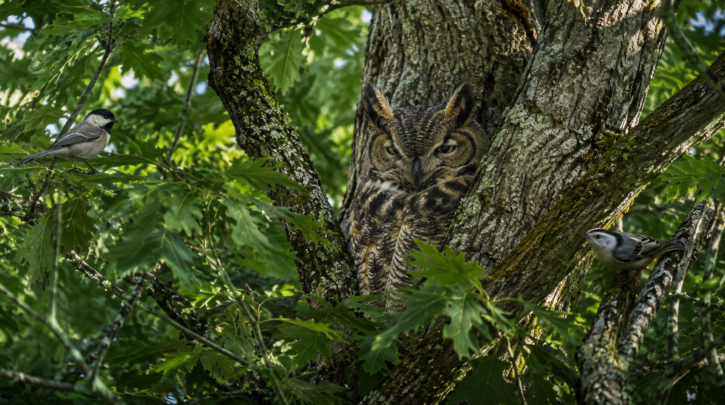
Outside Snowy Owl, most owls spend daylight hours roosting in dense foliage or a sheltered cavity, relying on camouflage plumage and complete stillness to avoid detection while genuinely vulnerable to discovery.
Mobbing: A Real Risk of Discovery
A roosting owl discovered during the day by songbirds or jays can trigger genuine mobbing behavior — the same alarm-calling and coordinated harassment, directed at a daytime predator caught at its most vulnerable rather than at a genuine active threat.
A roosting owl spotted during the day by a jay or a flock of songbirds can quickly find itself mobbed — loudly harassed and repeatedly dive-bombed until it abandons the roost entirely.
Hunting Strategy
Most owls hunt using a perch-and-wait ambush strategy, striking once prey is located by sound or sight. Barn Owl and Snowy Owl both also hunt using slow, low quartering flight over open ground, systematically covering territory rather than waiting from a single fixed perch.
Territorial Calling
Vocal activity, including territorial hooting and calling, is most concentrated at dusk and through the night, particularly during the breeding season, making early evening one of the most reliable times to actually hear this family even when sightings remain rare.
Want to actually observe this activity firsthand? See our red-light flashlight guide for gear that lets you watch without disrupting natural behavior.
A Final Thought on Timing
Owl watching genuinely rewards flexibility more than any fixed formula — a species-specific sense of timing, paired with genuine patience, consistently outperforms simply heading outside at random and hoping for a lucky encounter.
Treat each outing as a small experiment in matching effort to species, and the results tend to improve considerably faster than random trial and error ever would on its own.