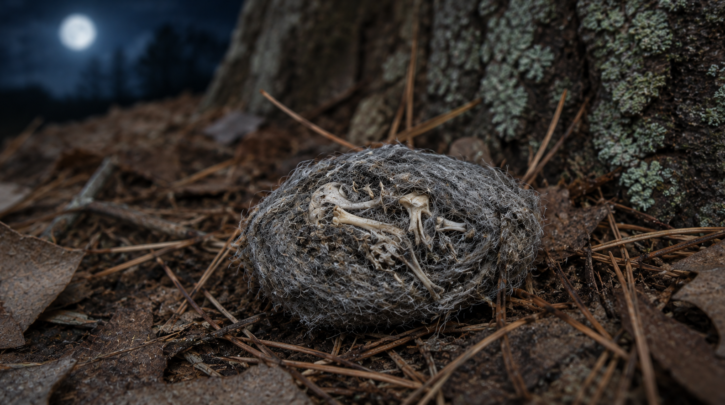

Few pieces of evidence reveal as much about a bird’s actual diet as an owl pellet does — a compact, regurgitated bundle of everything an owl couldn’t digest from its most recent meals.
What a Pellet Actually Is
Because owls often swallow prey whole or in large pieces, fur, feathers, bones, and insect exoskeletons pass into the gizzard rather than being digested. This indigestible material compacts into a dense pellet, which the owl regurgitates, typically once or twice a day, rather than passing it through the rest of the digestive system.
A Genuine Scientific Tool
Researchers studying wild owl diet frequently rely on pellet analysis rather than direct observation of hunting or invasive stomach examination, since a pellet preserves recognizable bone fragments, skulls, and fur that can be identified to species with a reasonable degree of confidence.
Why Barn Owl Pellets Are Especially Valuable
Barn Owl pellets are particularly prized by researchers because they tend to preserve small rodent skulls unusually intact, making species-level identification of prey considerably more reliable than it is with more fragmented pellet material from some other owl species.
A Real Classroom and Homeschool Tool
Sterilized owl pellets are sold commercially for educational dissection, widely used in classrooms and homeschool settings to teach food chains, skeletal identification, and basic diet analysis using a genuinely real, if processed, biological specimen rather than a simulation.
Finding Pellets in the Field
Pellets accumulating beneath a regular roost or nest site are one of the most reliable ways to confirm owl presence without ever seeing the bird itself, and examining several pellets from the same location can offer a genuinely useful window into what a specific individual or pair has actually been eating.
Distinguishing Pellets From Other Animal Sign
Owl pellets are generally more tightly compacted and uniform in shape than the droppings of most other animals, and a pellet containing visible fur or small bones is a fairly reliable sign of owl activity rather than another predator or scavenger.
Pellet Regurgitation and Feeding Timing
Because pellet formation and regurgitation generally happens between feeding sessions, finding a fresh pellet can sometimes indicate a roost site is currently or recently active, useful information for anyone trying to locate a specific bird without disturbing it directly.
Curious about trying pellet dissection yourself? See our pellet dissection kit guide for a genuinely hands-on way to explore this biology directly.
A Uniquely Direct Piece of Evidence
Few other pieces of evidence in backyard birding offer this direct a window into an animal’s actual diet — no inference required, just the physical remains of what was actually eaten, compacted and left behind for anyone willing to look closely.
Handling Pellets Safely
Wild pellets can carry bacteria and parasites, so handling one found in the field should involve gloves and careful hygiene afterward, or simply examining it without picking it up directly. Commercially sold, sterilized pellets used for classroom dissection avoid this concern entirely, having already been heat-treated for safe handling.
What a Careful Dissection Can Reveal
A single pellet can contain the remains of several prey items, and careful separation of bone fragments, sorted and compared against reference charts, can reveal not just how many individual prey items were eaten but often which species they belonged to.
Pellets as a Long-Term Monitoring Tool
Researchers monitoring a specific nest box or roost site over multiple seasons can use collected pellets to track how diet shifts across the year, offering a genuinely low-impact way to study a population’s ecology without disturbing the birds directly.
Pellets and Citizen Science
Some regional monitoring programs invite members of the public to report or submit pellet findings, contributing to a broader picture of local owl distribution and diet without requiring specialized equipment or advanced training beyond careful observation and basic record-keeping.
A Small Habit With Real Research Value
Simply checking beneath a known roost site every so often and noting what turns up costs almost nothing in time or effort. Repeated consistently over a season, it builds a genuinely useful personal record of local owl activity — direct, physical evidence gathered right in your own yard, and one of the most accessible ways to actually study owl biology without ever needing to see the bird itself.