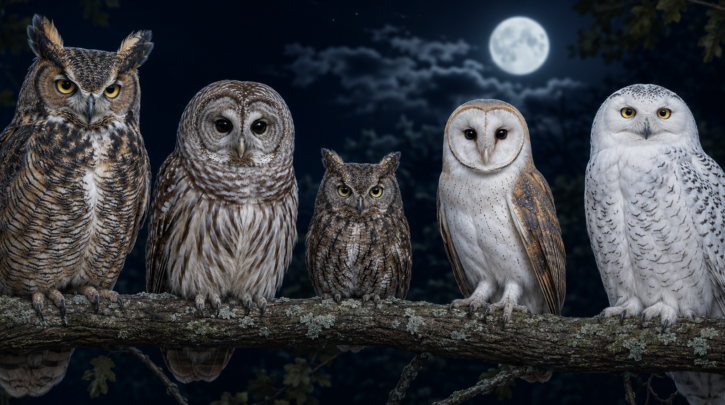

Five owl species cover most of North America between them, and despite sharing the same basic body plan, they differ enormously in size, facial shape, and habitat — from a ghostly, heart-faced Barn Owl to a pure white Arctic specialist.
Great Horned Owl
- Large and powerful, with prominent ear tufts often called “horns”
- Mottled gray-brown plumage, a white throat patch, and yellow eyes
- One of the most widespread raptors in North America, found in nearly every habitat type
- Deep, resonant hoot: a distinctive multi-note “hoo-h’HOO-hoo-hoo”
Barred Owl
- Large and round-headed, with no ear tufts at all
- Brown and white barring across the chest and vertical streaking on the belly
- Dark brown eyes — genuinely unusual, since most North American owls have yellow eyes
- Range: eastern and southern forests, with an expanding presence into the Pacific Northwest
- Famous call, often rendered as “who cooks for you, who cooks for you-all”
Eastern Screech-Owl
- Small, roughly robin to pigeon sized, with small but visible ear tufts
- Two distinct color morphs — gray and rufous (reddish-brown) — occurring within the same populations regardless of sex or age
- Common in suburban yards, parks, and woodland edges
- Call: a distinctive descending whinny or trill, not a hoot at all
Barn Owl
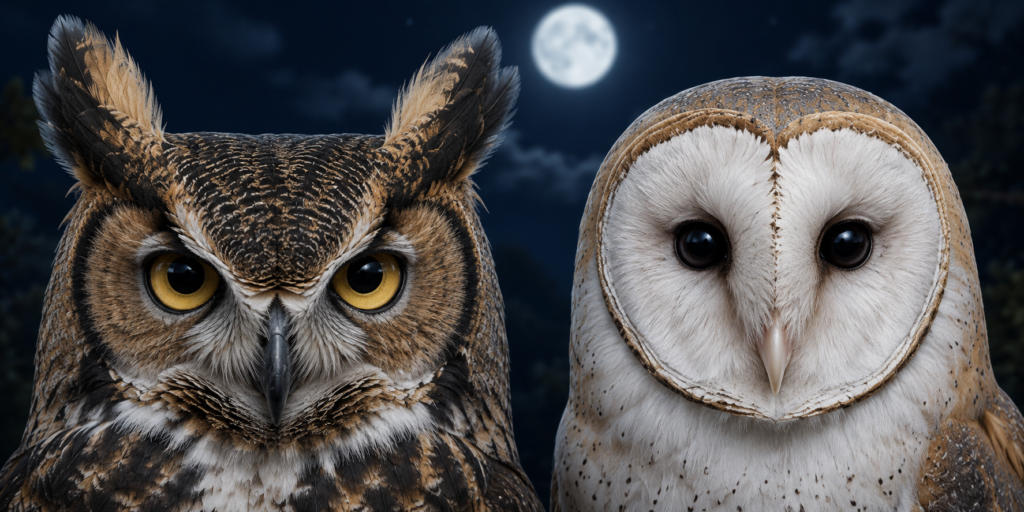
- Pale, ghostly overall appearance with a distinctive heart-shaped facial disc unlike any other species on this list
- No ear tufts, long legs, tawny upperparts, and white underparts
- Range: open farmland and grassland, often roosting and nesting in barns, silos, and other structures
- Doesn’t hoot — produces eerie screeches and hisses instead
Snowy Owl
- Large and predominantly white, with males typically whiter than the more heavily barred females
- No ear tufts, yellow eyes
- Breeds on Arctic tundra and shows genuinely unpredictable winter movement south in some years
- Unusual among owls for being active during the day, tied to the continuous daylight of an Arctic summer
The Ear Tuft and Face Shape Test
Ear tufts alone narrow things down quickly: Great Horned Owl and Eastern Screech-Owl both show them clearly, while Barred Owl, Barn Owl, and Snowy Owl are all tuft-less. Facial disc shape settles the rest — Barn Owl’s heart shape is unmistakable, and Barred Owl’s dark eyes stand out immediately against Snowy Owl’s yellow ones.
A Biology Note: Ear Tufts Aren’t Ears
Despite the name, ear tufts have nothing to do with actual hearing — they’re simply feathers, likely serving a role in camouflage and visual communication between individuals. The real ear openings sit lower on the head, hidden within the facial disc, covered in more detail in our silent flight and hearing guide.
Ear tufts aren’t ears at all — they’re just feathers, likely used for camouflage and visual signaling, while the actual ear openings sit hidden lower on the head.
Sexing Owls: A Note Before You Try
Most owl species show no reliable plumage difference between males and females, though size does differ — and in a genuinely unusual reversal covered in our male vs. female guide, females are typically the larger sex.
What to Do Once You’ve Made an ID
Identified an owl roosting in a tree during the day? See our nocturnal behavior guide for what’s actually normal daytime behavior for this family, and our habitat and range guide to confirm whether the species and location match up.
Not sure which species is visiting your yard after dark? Our red-light flashlight guide covers the gear serious owlers use to spot and identify owls without disturbing them.
Range Overlap
Great Horned Owl and Barred Owl overlap broadly across much of the eastern and central United States, generally separated by habitat and by Great Horned Owl’s willingness to occupy far more open country than Barred Owl typically tolerates. Barred Owl’s ongoing range expansion into the Pacific Northwest has put it in direct competition with the threatened Spotted Owl, a genuine and actively studied conservation concern.
Size as a Secondary Clue
Great Horned Owl and Barred Owl are both genuinely large, roughly similar in overall body length, while Eastern Screech-Owl is dramatically smaller — closer to a robin or pigeon in size than to either large species. Barn Owl and Snowy Owl both fall somewhere in between, making size alone a useful but not definitive clue without also checking facial shape and range.
Voice as the Most Reliable Clue After Dark
Because most owls are heard far more often than seen, learning each species’ call is often more practically useful than plumage alone — Great Horned Owl’s deep hoot, Barred Owl’s rhythmic phrase, Eastern Screech-Owl’s descending whinny, and Barn Owl’s eerie screech are distinct enough that most sightings in the dark are really identifications by ear.
A Family Worth Learning by Region First
Because these five species have relatively limited range overlap outside a couple of specific zones, knowing which owl is expected in a given region is often a faster path to confident identification than working through plumage details from scratch alone.