
Among the five species covered on this site, Great Horned Owl stands alone in a genuinely striking way: there’s no documented instance of the species constructing an original stick nest from scratch.
A Species That Reuses, Never Builds
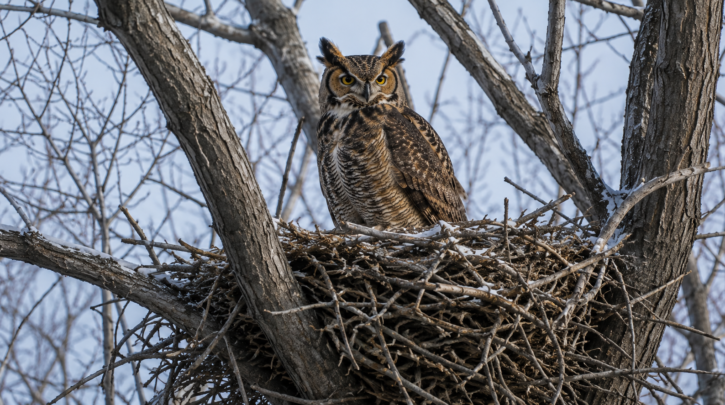
Great Horned Owl relies entirely on nests originally built by other species — most often hawks, crows, or herons — along with cliff ledges and occasionally large tree cavities. This isn’t an occasional shortcut; it’s the species’ only known nesting strategy.
The Timing Advantage That Makes This Work
Great Horned Owl nests unusually early in the year, often in winter, well before most hawks return to reclaim and refurbish their own nests for the coming spring. This timing gives Great Horned Owl first access to a nest site that would otherwise still belong to its original builder, a genuine ecological advantage created almost entirely by scheduling rather than by any direct confrontation.
Not Quite Theft, Not Quite Cooperation
This behavior generally involves occupying a nest that’s currently unused or from a previous season rather than actively displacing a hawk still using its own nest, though the early timing does sometimes mean a returning hawk finds its former nest already occupied by an owl that arrived first.
A Genuine Ecological Dependency
Because Great Horned Owl can’t create its own nest site under any circumstances, local population density is directly limited by the availability of suitable reusable nests, cliff ledges, or large cavities — a genuine ecological dependency on other species’ construction work that no other owl covered on this site shares to this degree.
There’s no known case of a Great Horned Owl building its own stick nest — the species has apparently never needed to, given how effectively early timing lets it claim nests other birds already built.
How This Compares to the Rest of the Family
Every other species covered on this site does at least some of its own nest preparation, whether that means selecting and lightly furnishing a cavity or scraping a shallow ground nest. Great Horned Owl’s complete non-participation in construction is genuinely unique even within a family already known for nesting flexibility.
What This Means for Conservation and Habitat
Supporting Great Horned Owl populations indirectly depends on supporting the hawk, crow, and heron populations that build the nests it eventually relies on, along with retaining large trees and cliff habitat — a genuinely interconnected conservation picture rather than something addressed through a single species-specific action alone.
Curious how the other four species covered here handle nesting instead? See our full nest guide for the complete range of strategies across this family.
A Behavior With Real Historical Documentation
Ornithologists have documented this reuse pattern extensively across decades of nest monitoring, and the complete absence of any recorded original construction, despite how thoroughly this common, widespread species has been studied, makes a strong case that this genuinely is the species’ only nesting strategy rather than simply an underreported alternative.
A Useful Lesson for Backyard Observation
Finding a large, sturdy stick nest occupied unusually early in the year, well before most hawks would normally be active, is a reasonable early clue that a Great Horned Owl may have claimed it ahead of the original builder’s return.
A Fitting Closing Thought
Few pieces of owl biology illustrate evolutionary opportunism as clearly as this one — rather than investing energy in construction, Great Horned Owl simply arrived earlier than everyone else and let that timing do all the necessary work.